
In The Diviners, Margaret Laurence ’72 (hon) wrote of an “impossible contradiction” – a river that seemed to “flow both ways.” Many readers have long suspected the image was drawn from the Otonabee River in Peterborough, whose currents twist and fold back on themselves as they wind through the city.
For nearly six decades, Faryon Bridge has spanned that same stretch of water at the heart of Trent University. Each day, thousands of students and faculty cross its concrete deck between the East and West Banks, often without pausing to consider the structure beneath their feet or the role it has quietly played in shaping the life of the campus.
Now, as the bridge enters a major rehabilitation after more than half a century of use, its story offers a window into the architectural ambitions that shaped Trent’s riverside campus and the generations of memories that have accumulated along its span.
Where the Campus Meets the River
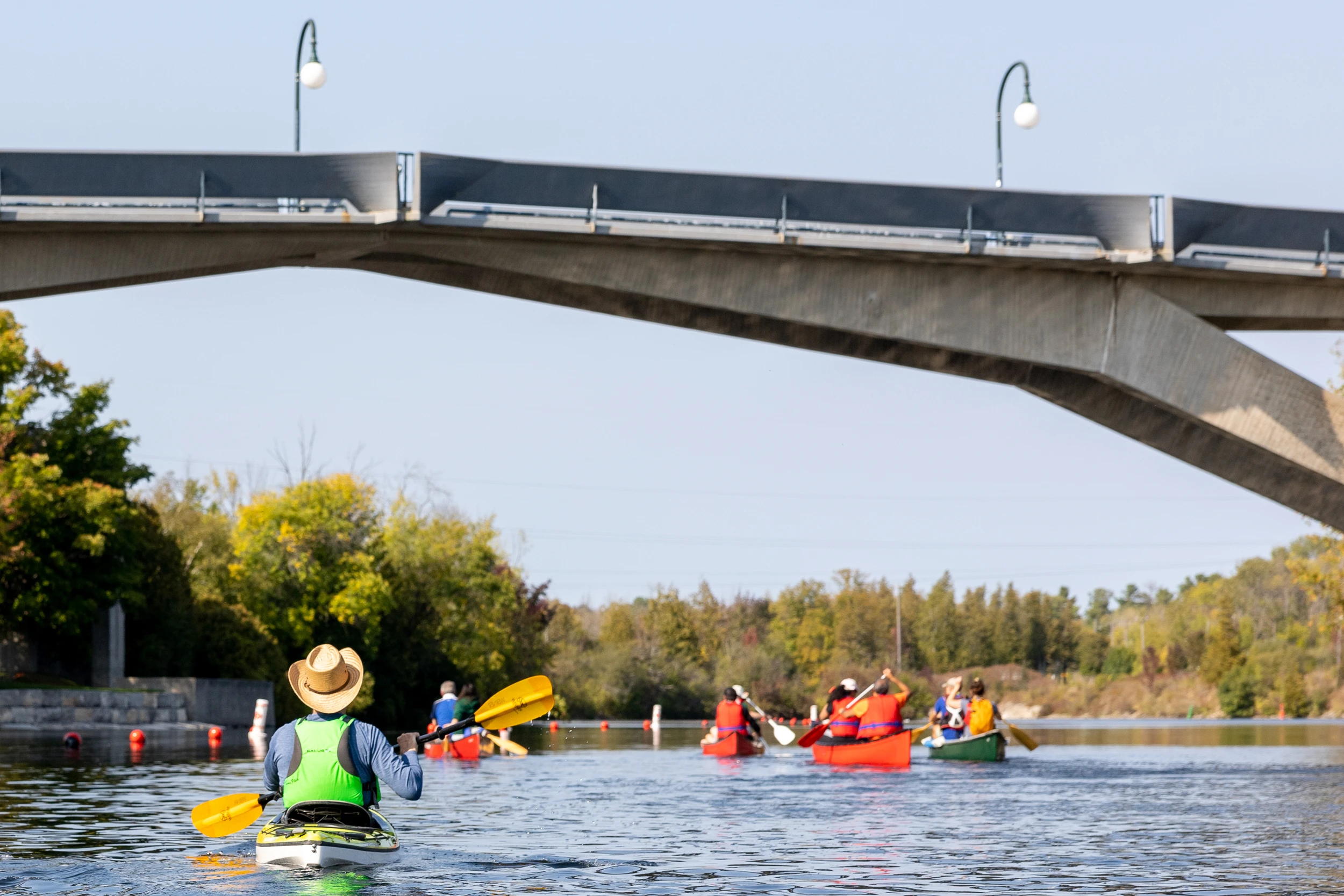
On paper, Faryon Bridge is defined by a series of practical considerations. It is the only pedestrian link across the Otonabee River on campus. Beneath the walkway, it also houses key electrical and communications networks that connect the East and West Banks. Its central arch is designed to be 25 feet above the river to accommodate boat traffic on the Trent-Severn Waterway, a federal waterway that is part of the Great American Loop.
"Yet, for anyone who has walked across it, rowed under it, or just gazed at its silhouette from the shore, the bridge is also the metaphorical heart of campus. The river it spans is known in Anishinaabemowin as Odoonabii-ziibi, meaning “the river that beats like a heart”. It is fitting, then, that this crossing has long served as the symbolic centre of the University and unsurprisingly has done so by design."
Dr. MichaelEamon

The Origins of an Icon
When architect Ron Thom began designing Trent’s campus in the early 1960s, he imagined a university organized around the river itself. He designed a pedestrian-focused, collegiate university that would embrace the “spirit of place” by surrounding the river.
“The Otonabee River is the main feature of the University site,” he wrote. “A vital feature of such importance could hardly fail to be considered as the centre of the campus.”
Paul Merrick, lead architect for the Chemistry Building and Bata Library, was tapped to design the “northern bridge” with renowned structural engineers Morden Yolles and Roland Bergmann.
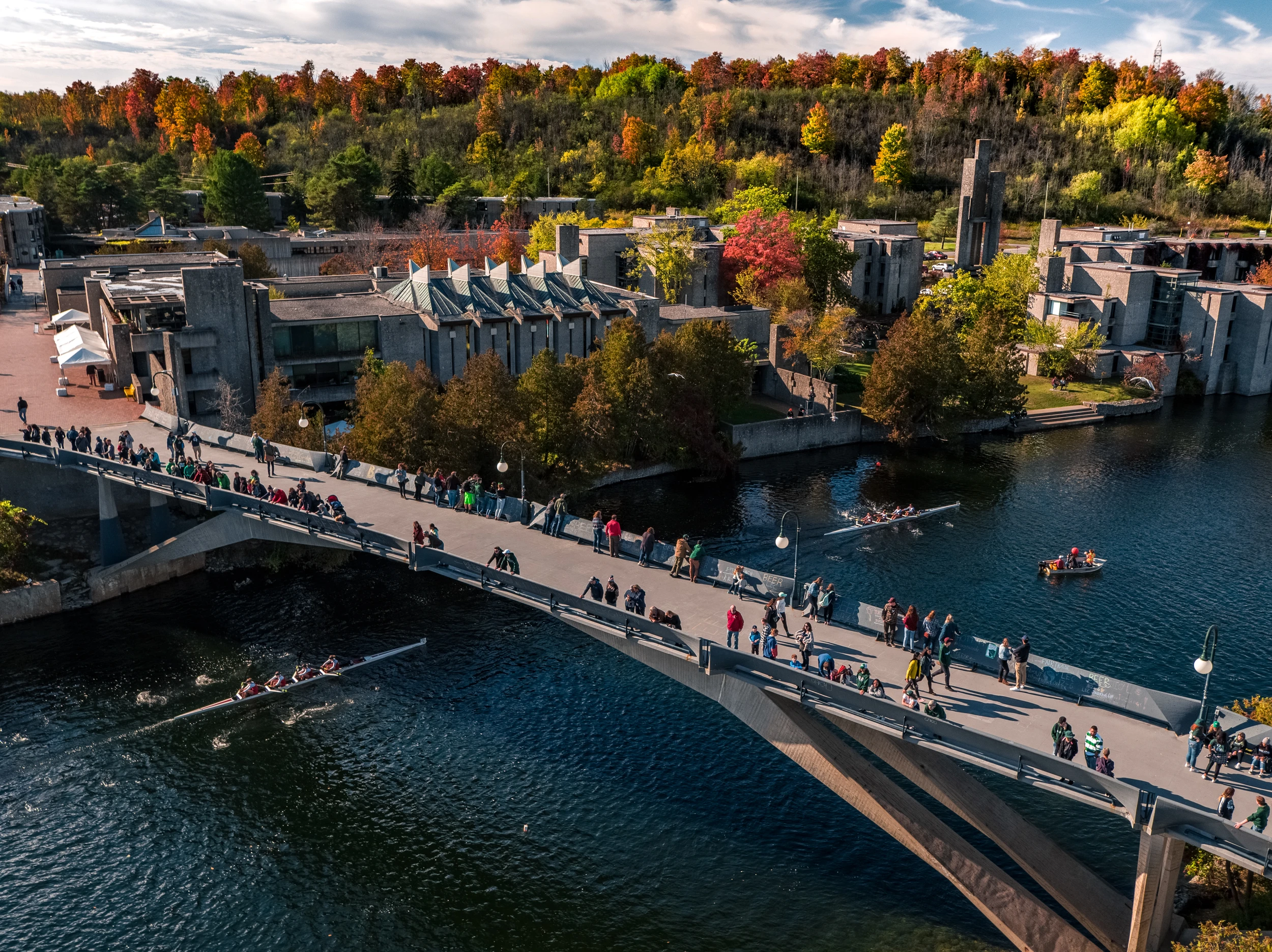
Stretching 182 feet across the Otonabee, the bridge reflects Thom’s architectural vision and the distinctive rubble aggregate features seen elsewhere on campus. Their design incorporated parabolas for the arches below and gull-winged balustrades for the decking above.

Where Paths Cross
The bridge is a cornerstone of campus life – a gathering place, a vantage point, and a backdrop to countless small moments that now form part of Trent’s collective memory.
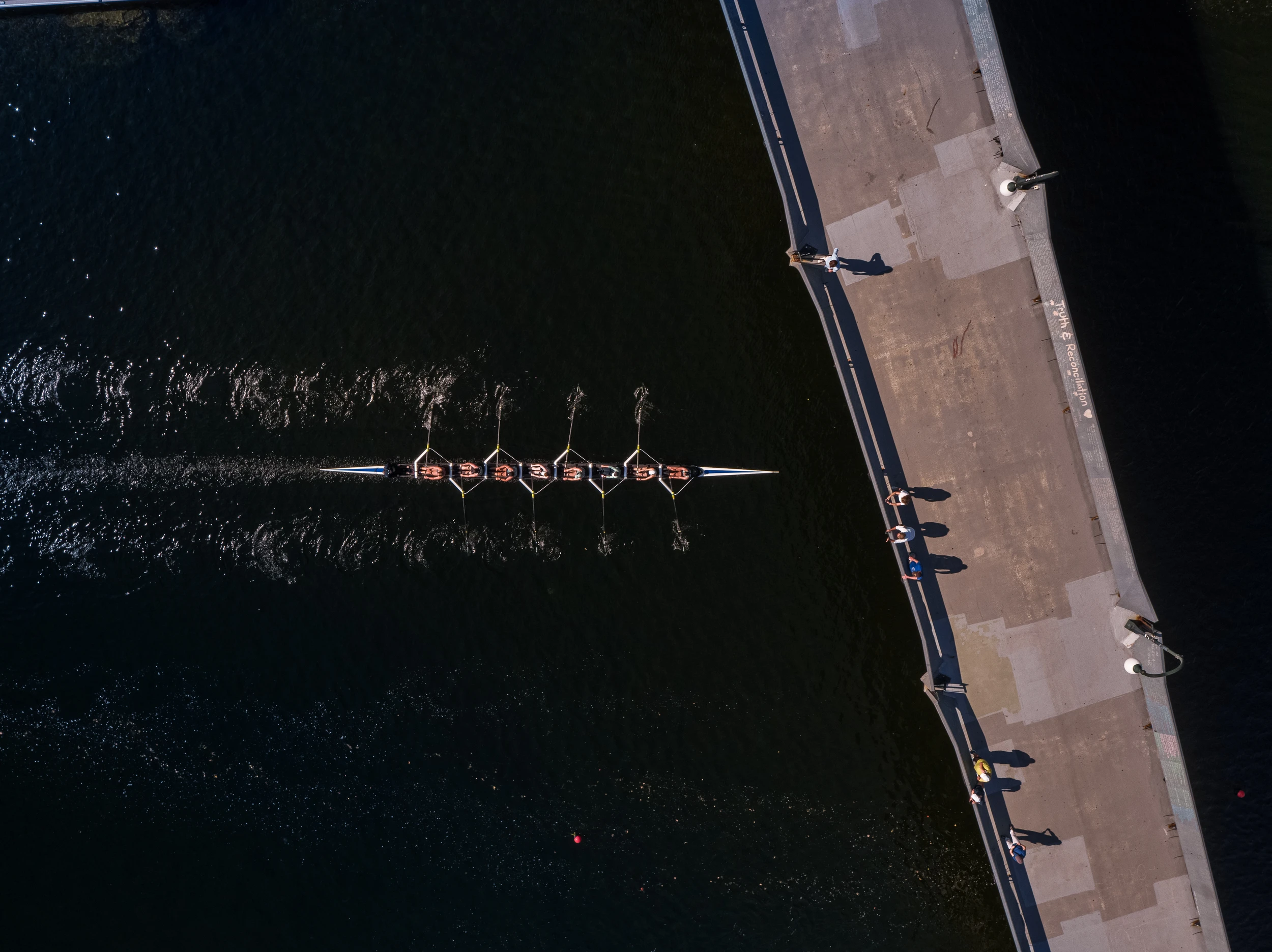
As Sierra Sumner ‘18 (Gzowski College) fondly recounts: “We waited by the water for the Head of the Trent to begin, with Faryon Bridge behind us and a quiet sense of anticipation in the air.”
For Sierra and her friends, “wearing our Trent gear and ready to cheer,” formed a quintessential Trent moment where “it felt like the calm before the action as the riverbanks filled with spectators. Moments like this perfectly capture the spirit of Trent and the traditions that bring us back year after year!”
Regardless of the era, crossing the bridge in every imaginable weather condition is considered a badge of honour for Trent students.
“It was a day after a freezing rainstorm in late November. I was crossing the bridge to class, trying to juggle a drink, a sandwich, and my binder when suddenly my frictionless plastic binder slipped from under my arm, hit the not-quite-melted ice, and with a horrifying acceleration went sliding into the river. A term’s worth of notes gone in the blink of an eye!”
GeoffBacka '84(Lady Eaton College)
Over the years, Faryon Bridge has played a supporting role in many of Trent’s love stories. Countless students have walked across it together, exchanged phone numbers, or paused to admire the sweeping view, and sometimes each other.
For Dawn Berry-Merriam ’72 (Champlain College), the bridge was where she first met her future husband, John, on September 13, 1972. “The bridge offers a wonderful vista to look across the water,” she recalls,“ and if you look carefully, you can see the future – we did.”
Years later, after John passed away, Dawn created a shadow box of memories that includes a small but meaningful keepsake: the medallion she gave him for Christmas in 1972, engraved with the words “meet you on the bridge.”
For Maria Tullio ’10 (Otonabee College) and Nathaniel Palmer ’11 (Gzowski College), whose wedding was postponed due to the COVID-19 pandemic, Faryon Bridge became a place to hold onto connection.

“Nathaniel and I met through mutual friends while studying at Trent. The significance of taking the photos on the bridge is that we went to school and met there. So many amazing things happened for us while we studied at Trent, and we are eternally thankful for our experiences there. They led us straight to each other, exactly where we were meant to be!”
MariaTullio '10(Otonabee College)
Restoring Faryon Bridge
In just a few years, Trent will mark the 60th anniversary of its iconic Faryon Bridge.
Over time, the bridge has become more than a point of crossing. It is a place of celebration and protest, of quiet conversations and shared milestones, woven into the everyday rhythms of campus life.
Yet landmarks like this cannot be taken for granted. After more than 50 years of service, Faryon Bridge requires significant rehabilitation to remain safe, functional, and true to its original design.
The rehabilitation project, now underway, will preserve both the structure’s function and its distinctive architectural form. The work will unfold over multiple construction seasons and includes renewing the deck and balustrades, restoring the beams and arches that support the span, and strengthening the piers and foundations beneath it. Environmental safeguards will guide every phase to protect the Otonabee River and its surrounding habitat. Trent has raised more than $6 million in donations towards the rehabilitation project, led by a transformational gift from Doug Kirk ’70 (Champlain College), former chair of Trent’s Board of Governors, and his partner, Mary ‘26 (hon) and donations from other alumni.

When the work is complete, Faryon Bridge will continue to carry the daily crossings of students, faculty, staff, and alumni, its span linking not only the East and West Banks, but generations of memories shaped along the river
it crosses.
Like the current beneath it, the story of Faryon Bridge continues to flow through the life of the University.